
Leadership Development Model
The step-by-step progression from sales representative to executive leadership.


The journey for a Sales Rep begins at the entry-level.
In this phase the goal is to learn how to grasp the sales systems and to apply them so they are consistently achieving weekly sales targets (between $700-$1000/week in commissions)
The average person spends anywhere between 4 - 8 weeks in this phase before moving into Phase 2.


In this phase, Leaders are responsible for maintaining consistent weekly sales production while learning how to train and retrain others.
The primary learning curve in Phase 2 is selling effectively in the field alongside Trainees and transferring skills in real time so they can consistently hit weekly sales targets.
Weekly commissions typically remain consistent, and may occasionally increase, as individuals continue selling full-time while training others. As tenure and experience grow, they often rank higher in production, which can lead to additional bonuses and spiffs.
Most individuals spend approximately 4–6 months in this phase before advancing to the next stage.


Leaders who advance to Phase 3 have demonstrated the ability to maintain consistent weekly sales performance while training others. Advancement to this phase typically requires successfully developing and retaining at least two Sales Representatives who have progressed into Phase 2 and are now productive Trainers within their office.
The objective in Phase 3 shifts from individual production to team development. Promoting Leaders must learn to work through others — not only transferring skills, but influencing performance, accountability, and resilience through challenges.
This phase represents the most difficult transition in the model. Historically, fewer than 20% of Sales Representatives successfully build a productive team in this stage to qualify for Phase 4.


To advance to Phase 4, a Promoting Leader must build and sustain a team of 7–10 representatives, including at least 4 Leaders they have personally recruited and developed. The team must also generate $6,000 in weekly commissions for two consecutive weeks.
As an Assistant Manager, the focus shifts to maintaining team size and production while learning the operational responsibilities required to run a profitable office (OSP). At this stage, individuals typically transition from contractor to employee status and divide their time between field sales and in-office training to prepare for becoming a Sales Partner.
A percentage of their weekly team's profit is allocated to a startup fund, with a typical target of $20,000 required to support the launch of their future office. An Assistant Manager typically spends 8-12 months in this phase before advancing to OSP.


Achieving Phase 5 is a significant milestone. At this stage, the individual becomes an Outsourced Sales Partner (OSP) and is awarded a contract to recruit, train, and sell on behalf of Clients within the Inkeros ecosystem.
While the core mission remains the same, the financial upside increases substantially. The focus shifts to operating and scaling a profitable office within assigned markets and channels.
The objective at this level is to build and develop a network of sales offices, investing in leadership growth and long-term expansion. For additional details on earning potential and growth incentives, see the OSP Referral Bonus Incentive section.
OSP Referral Bonus Incentive
A structured incentive aligned to organizational expansion and revenue growth.


Tier 1 represents the first milestone after an OSP launches their office. While the initial $20,000 startup fund supports operational setup, OSPs are expected to immediately reinvest in growth by accelerating recruiting and developing their team.
The objective is to build and promote new Leaders into the same OSP opportunity they received.
Once an OSP successfully promotes a new OSP into a separate market, they achieve Tier 1 status and earn a 4% override on the new office’s production.
.png)

Tier 2 is achieved when an OSP has built a minimum of four offices within their organization, including at least one second-generation OSP.
At this level, the Promoting Owner continues to earn a 4% override on all first-generation offices and additionally earns a 1.5% override on the weekly production of second-generation offices - as long as their organization is generating a minimum of $100,000 a month in commissions revenue


Tier 3 represents Consultant status and is recognized through a public promotion at a major national Inkeros event.
To qualify, an OSP must build an organization of at least 10 active offices producing a minimum of $400,000 per month in total commission revenue.
At this level, override rates increase to reflect expanded scale and leadership impact:
-
5% override on all first-generation offices
-
2% override on all second-generation offices
-
1.5% override on all third-generation offices

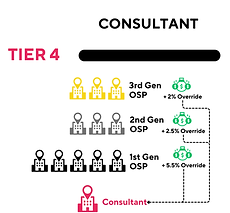
Tier 4 represents expanded scale and sustained organizational performance. To qualify, a Consultant must operate a minimum of 12 total offices generating at least $700,000 per month in total commission revenue across the organization.
At this level, override percentages increase to reflect the size and impact of the organization:
-
5.5% override on all first-generation offices
-
2.5% override on all second-generation offices
-
2% override on all third-generation offices

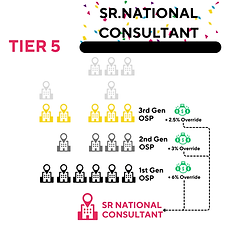
Tier 5 represents Senior National Consultant status and is recognized through a public promotion at a major Inkeros event.
To qualify, a Consultant must build an organization of at least 20 total offices producing a minimum of $1,000,000 per month in total commission revenue.
At this level, override rates increase to reflect national scale and sustained multi-office leadership impact:
-
6% override on all first-generation offices
-
3% override on all second-generation offices
-
2.5% override on all third-generation offices
Any generations beyond third-generation do not generate overrides for the Senior National Consultant. Overrides for fourth-generation offices and beyond are earned by their respective Promoting Owners and Consultants in accordance with the Tier guidelines.